Watch provenance
that only you can show.
Rolex, Patek Philippe, Audemars Piguet, Richard Mille, Vacheron Constantin, Cartier, Omega, F.P. Journe and the independents; rings, gemstones, Cartier, Tiffany, Van Cleef & Arpels, Graff; Hermès Birkin and Kelly, Chanel, Louis Vuitton, Dior. Reference, serial, certificates, valuations and services - watch provenance and jewellery provenance sealed as evidence, registered by the insurer that specifies the item or the dealer that sold it, and readable only under a scope you grant. Brand passports cover new goods; for a pre-owned watch, this is the Owner's own record. Never a public register of who owns what.
- Specified on schedule · serial, valuation, photographInsurer
- Authentication · movement and dialAuthenticator
- Serial, reference, ownerHidden unless scoped
The pieces people keep in a safe and carry in their head.
One record type for the whole class - watch provenance, jewellery provenance and handbag authentication on the same timeline. Brands are named as the goods people own, never as partners.
Watches
LaunchingJewellery
LaunchingFashion
LaunchingPaintings are Art; antiques are Collectables.
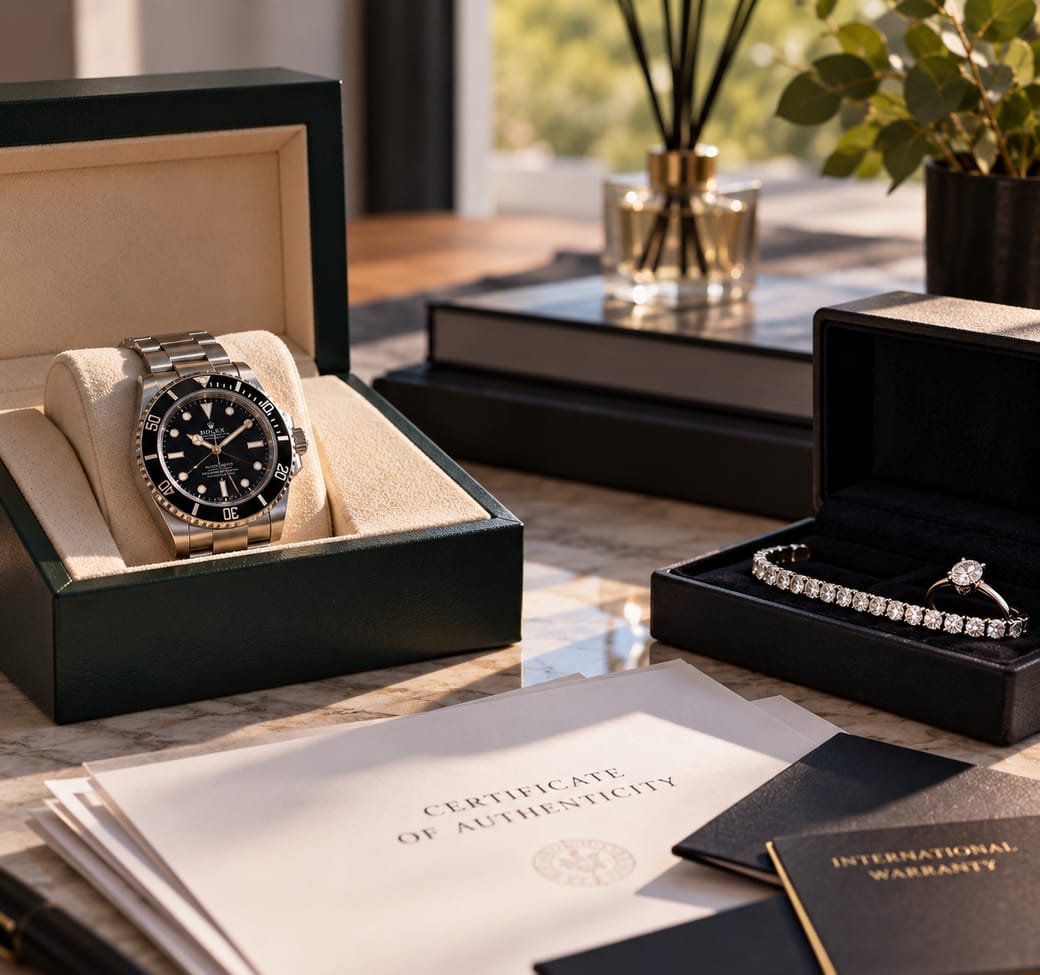
Watch box and papers, with the papers finally vouched for.
A watch is worth more with its papers, and the papers are the easiest part to forge.
Documents are hashed on upload and given an integrity receipt; corrections are stored as new versions. Each entry - warranty card, watch service history, valuation - is named to its issuer and date, and the watch provenance follows the piece to the next Owner under one digital asset identity.
-
IdentityNatural keys held off-chain, never published; the serial is held encrypted - never searchable by serial, never public. The Vault ID names the record.Brand · reference · serialGIA / IGI certificate numberPV-GB-{AREA}-{6 digits}
-
DocumentsWhat came with it, and since.Box and papersWarranty cardGemmological certificatesAuthentication reportsWatch service historyJewellery valuation certificatesInsurance schedule
-
OwnershipTransfer keeps the history.Owner and transfersOwner-granted scopes
-
EventsEach with the evidence it expects.Purchase Service Authentication Brand-passport import Stolen-register check (manual) Valuation Claim Sale
What is built for watches and jewellery Launching
The record: brand, model and reference, with the serial held encrypted - never searchable by serial, never public. The event templates: purchase, service, authentication, brand-passport import, and a stolen-register check as a verified manual workflow - a dated check against The Watch Register recorded by a registered dealer with sealed evidence; an automated check needs a data contract. The Provenance Passport is the dealer's workflow. The class is built but switched off while it is in development; when it launches it opens for every registered dealer and jeweller at once, and registering does not switch it on early. Nothing here is a public register of who owns what.
Jewellery provenance: the chain, as the class is designed
Each link is an event with its issuer and date. The last is optional and subject to regulatory approvals.
- Certificate
- Appraisal
- Provenance
- Ownership
- Insurance
- Valuation
- TokenA pointer, never title
A pre-owned watch: what to keep.
A new watch leaves the boutique with its papers; a pre-owned watch arrives with whatever the last owner kept. The Vault takes what exists, seals each item to its issuer and date, and grades it - owner-only evidence is capped at 65 in the Vault Score, so the dealer's, the insurer's and the service centre's entries matter.
The full list of watch and jewellery documents to keep is in the guides.
Watches
- Warranty card with the retailer and date, and the original receipt
- Watch box and papers: booklets, hang tags, the dealer's certificate on a pre-owned purchase
- Watch service history: service papers from the brand or an independent watchmaker, with parts replaced
- Photographs of the reference and serial as engraved, and of the movement where a service exposed it
- A valuation for luxury watch insurance and the insurer's specified-items schedule entry
Jewellery and handbags
- Gemmological certificates (GIA, IGI or equivalent) with the certificate number
- A jewellery valuation certificate for insurance, with its valuer and date
- Receipts, the maker's certificate and any resizing or repair records
- For a handbag: the receipt, the date or serial stamp photographed, and a handbag authentication report on a pre-owned purchase
- Each transfer as an event, so jewellery provenance stays whole between owners
Registered by whoever has money on the piece. Read by whoever is about to.
Owners grant every scope on their record; scopes hide documents, not history; opens are logged.
Who registers
- The insurer that specifies the item - serial, valuation and photograph, into a record the policyholder owns.
- The dealer that sold it - the Provenance Passport, through Pro.
- Authenticators and auction houses - reports and the catalogue entry.
- The Owner - receipt, box, photographs; owner-only evidence is capped at 65.
Who reads, under scope
- Insurers at claim - serial, valuation and photographs as sealed before the loss: Claim Evidence Report.
- The next buyer - which documents exist and who issued them, before money moves.
- Auction houses at consignment - provenance without posting originals.
- Stolen registers - theft recovery only through the register's own process, under an agreement.
Private by default
No lookup by serial; nothing reachable without a scope identifies a watch, a stone or a person. Property Vault never holds the goods, the keys or the money. Security
Watch provenance, stage by stage. The same published engine.
Each stage is designed to list the evidence it expects and who may issue it. A watch service:
Received
Intake receipt; reference and serial.
Serviced
Work carried out; parts replaced.
Returned
Service card; pressure test.
Valued
Valuation for the schedule.
Vault Score
A verification score - whether the documents exist, who issued them and that they are unaltered since issue; never a valuation, a credit input or a judgement of the work.
The verification score method, publishedVerified History
Every event, document and owner, sealed on upload and graded by who issued it. A service centre's card outranks an Owner's photograph.
How Verified History records asset provenanceA collection as units, through a regulated issuer.
Property Vault Markets - tokenised ownership, collateral and lending for verified real-world assets on the XRP Ledger - launches through regulated partners, subject to regulatory approvals. Roadmap · subject to approvals
Structures the class is designed for
- Fractional ownership of a watch collection or a significant jewel, through regulated issuers
- Lending against a verified collection, through regulated lenders reading the Vault API - see borrow against assets
Property Vault supplies the Vault ID, Verified History, Vault Score and eligibility data. It never hosts an offer, gates holders, runs a venue, holds keys or moves money.
Two camps hold the trust. Neither belongs to the owner.
The pre-owned owner holds nothing portable.
The stolen register
Has this serial been reported lost or stolen? Nothing on who serviced it or whether the papers are genuine.
The brand passport
Breitling, every new watch since 13 Oct 2020 (Breitling, Oct 2020); Aura, 20+ brands, 17m+ products (Retail Insight Network / CB Insights, 2024-25). New goods only; nothing for a 1998 Rolex.
The Vault instead
Owner-controlled: the insurer's entry, the dealer's certificate and the service card on one sealed timeline, read under scope - a watch ownership register that belongs to the owner.
Registers and brands named here are market context, not partners.
Where Luxury stands today.
Luxury - watches and jewellery first - is the next class after Property, launching with the partners who register it - insurers' specified-items teams, specialist dealers and auction houses. The record, its templates and the manual stolen-register check are built, and stay switched off until the class launches; dealers and jewellers who register now are first in line. The engine beneath it is live in pilot for Property.
Insurers
Specified items registered at quotation for luxury watch insurance; insurance claim evidence at loss.
Claim Evidence ReportDealers and auction houses
Pre-owned watch authentication and the Provenance Passport: what was sold, as described, by whom.
Provenance PassportOwners
Property is live in pilot. Open a Vault for your home today.
Get startedSister class: Vehicles, launching after watches and jewellery.
Watch provenance: common questions
Box and papers, serial lookups, stolen registers and what launches when.
What is watch provenance?
The documented chain from the retailer that sold a watch to its owner today: warranty card, receipts, service papers, valuations and each transfer. In a Vault every document is sealed on upload with an integrity receipt, named to its issuer and date, and shared only under a scope the Owner grants - the same asset provenance record every class uses.
What do "watch box and papers" mean, and what if I have lost them?
The original box, warranty card, booklets and receipt. Without them the watch provenance still holds what you do have - service papers, photographs of the serial and reference, a jeweller's valuation, an authentication report - each graded by who issued it; owner-only evidence is capped at 65. The Vault Score is a verification score - whether the documents exist, who issued them and that they are unaltered since issue; never a valuation, a credit input or a judgement of the work.
Can anyone look up my watch by serial number?
No. There is no lookup by serial, and nothing reachable without a scope identifies a watch, a stone or a person. Watch provenance is private by default: the Owner grants time-limited, role-limited scopes to an insurer, a buyer or an auction house; every open is logged. Property Vault never holds the goods, the keys or the money.
Does Property Vault check whether a watch is stolen?
No. Stolen registers run their own process, and Property Vault holds no register data unless under a data agreement with the source named. A Vault is the Owner's positive record, not a stolen register; the two answer different questions.
Does a jewellery valuation certificate belong in the Vault?
Yes. A valuation is sealed with its valuer and date and sits beside the gemmological certificate and the insurance schedule. The insurer that specifies the item can register serial, valuation and photograph into a record the policyholder owns, and read it at claim as insurance claim evidence - launching.
Is handbag authentication covered?
Yes. Hermès, Chanel, Louis Vuitton and Dior pieces sit in the Luxury class. An authenticator's report is sealed to its issuer and date and graded by the published engine; a dealer's sale is issued as auction house provenance through the Provenance Passport. The brands are named as the goods people own, never as partners.
When does the Luxury class launch?
Watches and jewellery are the next class after Property, launching with the partners who register it - insurers' specified-items teams, specialist dealers and auction houses; no launch date is published. Vehicles follow; see classic car history.
Register interest for Luxury.
Tell us what you keep and we will tell you when the class opens.